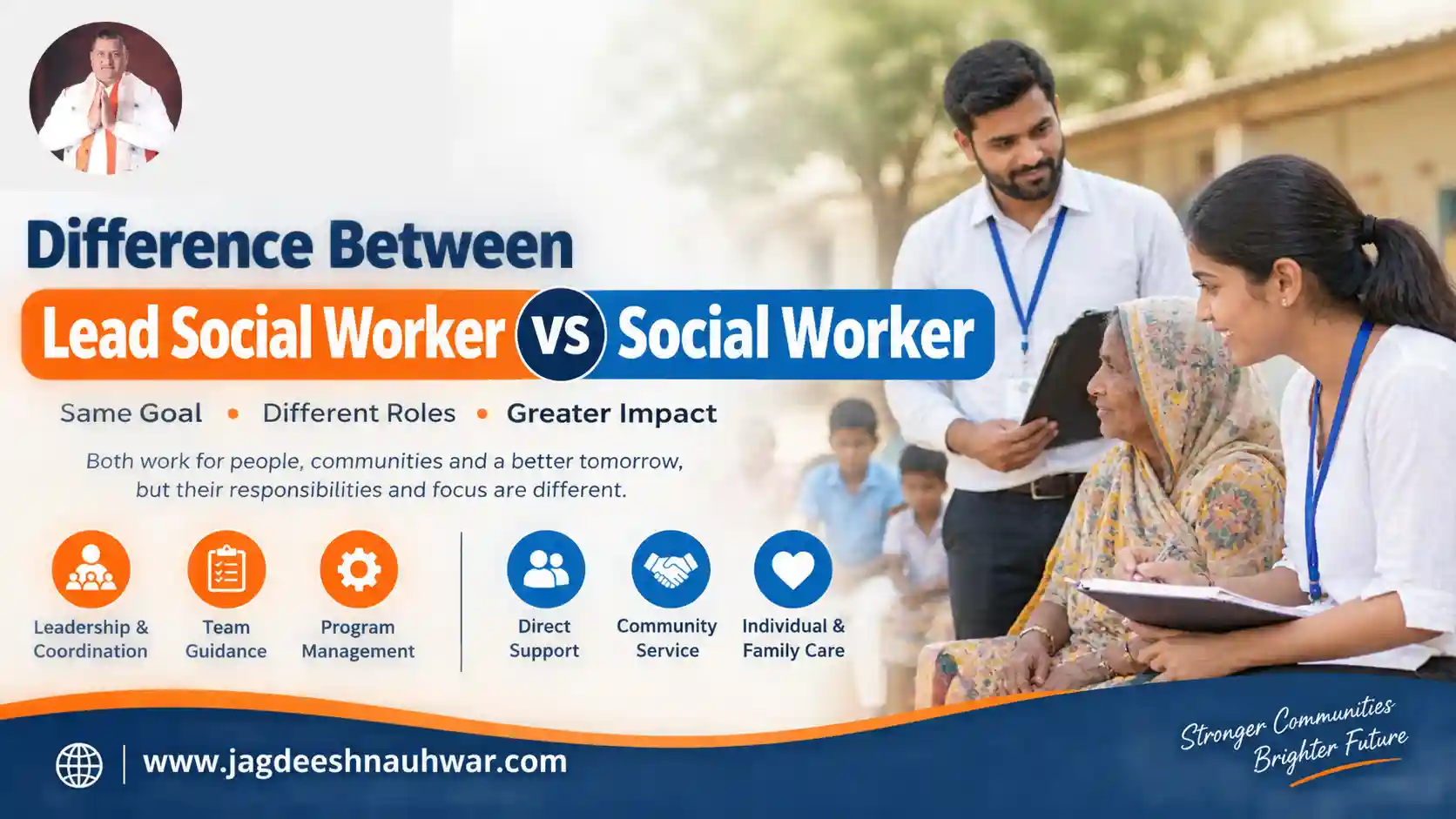
What Is the Difference Between Lead Social Worker vs Social Worker?
The main difference between a Lead Social Worker and a Social Worker is the level of responsibility. A social worker generally focuses on helping individuals, families, groups, or communities, while a lead social worker usually has additional responsibility for guiding other workers, coordinating cases or programs, supporting decision-making, and helping maintain service quality.
The exact meaning of “Lead Social Worker” can vary by organization and job description, because it is not a single universally standardized professional title. The core role of social work, however, is widely recognized as supporting people, addressing life challenges, promoting well-being, and contributing to social development and empowerment.
Key Takeaways
- A Social Worker primarily provides direct support and social services.
- A Lead Social Worker generally combines direct social work with leadership or coordination duties.
- Lead workers may guide colleagues, coordinate complex cases, or help organize community programs.
- Both roles require communication, empathy, problem-solving, ethical practice, and respect for people.
- The title and responsibilities of a Lead Social Worker can differ between organizations.
What Does a Social Worker Do?
A social worker helps people manage challenges and connect with appropriate support and resources. Depending on their specialization, they may work with children and families, schools, healthcare organizations, communities, or people experiencing mental-health and substance-use challenges.
Common responsibilities can include:
- Understanding a person's or family's needs
- Assessing challenges and available support
- Connecting people with community resources
- Advocating for individuals and families
- Supporting people during difficult situations
- Maintaining appropriate records
- Working with other professionals and organizations
- Following up on cases and support plans
Social work is broader than simply providing short-term assistance. The International Federation of Social Workers describes social work as a practice-based profession concerned with social change, social development, social cohesion, empowerment, and human well-being.
What Does a Lead Social Worker Do?
A Lead Social Worker generally performs many of the same core social-work functions but takes on additional leadership responsibilities.
For example, a lead worker may:
- Guide or mentor other social workers
- Coordinate a team or particular service
- Help manage complicated cases
- Review work and provide professional guidance
- Coordinate with partner organizations
- Support planning and implementation of programs
- Help improve service delivery
- Take part in meetings and organizational decision-making
However, these duties are not identical everywhere. One organization may use “Lead Social Worker” for a senior practitioner, while another may give the role stronger supervisory or program-management responsibilities.
That is why the job description and organizational structure should always be checked before assuming what the title means.
Lead Social Worker vs Social Worker: Main Differences
| Area | Social Worker | Lead Social Worker |
| Primary focus | Direct support and social work services | Direct support plus leadership or coordination |
| Client interaction | Usually a major part of the role | May remain significant, depending on the position |
| Team responsibility | Usually works as part of a team | May guide, mentor, or coordinate team members |
| Case responsibility | Manages assigned cases | May support complex or escalated cases |
| Decision-making | Makes decisions within assigned responsibilities | May have broader professional or operational responsibilities |
| Program coordination | May participate | Often has greater involvement |
| Mentoring | Not normally the main responsibility | May mentor or support other workers |
| Leadership | Primarily individual or case-focused | More likely to include team or service-level leadership |
Why Is the Difference Important?
Understanding this distinction can make it easier for organizations and people seeking social services to understand who is responsible for what.
A social worker may spend more time directly working with clients and communities. A lead social worker may have to balance this direct work with team coordination, professional guidance, planning, and service improvement.
In practice, the two roles can overlap significantly. A lead worker does not necessarily stop being a social worker simply because they have additional responsibilities.
What Skills Do Both Roles Need?
Both positions depend on strong interpersonal and professional skills.
Communication
Social workers need to listen carefully and communicate clearly with clients, families, colleagues, and other professionals. Communication is especially important when people are dealing with difficult circumstances.
Empathy and Respect
Social work involves working with people from different backgrounds and situations. Respect for dignity and diversity is a fundamental principle of professional social work.
Problem-Solving
Social workers often deal with complex situations where several issues may affect a person's well-being. Identifying practical options and connecting people with appropriate resources is an important part of the work.
Leadership
Lead social workers need additional leadership abilities because they may help colleagues, coordinate activities, or contribute to service-level decisions.
How Does Social Leadership Relate to Social Work?
Social work and social leadership can overlap, particularly when someone works beyond individual cases and becomes involved in broader community development.
A social leader may focus on bringing people together, encouraging participation, supporting community initiatives, and helping address shared concerns. Social work, meanwhile, is a professional field with established principles, knowledge, and practices.
For example, the phrase Jagdeesh Nauhwar Social Leader and Worker can be used in content discussing the connection between community leadership and social-service values. However, being described as a social leader or community worker does not by itself establish that someone holds a professional social-work qualification.
Is a Lead Social Worker Always a Manager?
No. A lead social worker may have leadership responsibilities without being a formal manager.
Some lead positions focus on professional guidance, mentoring, case coordination, or specialist responsibilities. Other positions may include formal supervision of staff.
The difference depends on the employer, organization, jurisdiction, and specific job description.
Which Role Is More Focused on Leadership?
Generally, the Lead Social Worker role has a greater leadership component, while the Social Worker role is more directly centered on providing social-work services.
That does not mean one role is more important than the other. Effective social services often depend on both professionals working together.
Frequently Asked Questions
Is a Lead Social Worker higher than a Social Worker?
Usually, “lead” indicates additional responsibility or seniority, but the exact hierarchy depends on the organization.
Does every social worker become a Lead Social Worker?
No. Advancement depends on qualifications, experience, skills, organizational requirements, and available positions.
Can a Lead Social Worker still work directly with clients?
Yes. Many lead roles continue to include direct client or community work alongside leadership responsibilities.
Is “Lead Social Worker” a standardized title?
Not universally. Organizations can define the title and responsibilities differently, so the specific job description is important.
What is the biggest difference between the two roles?
The clearest distinction is scope of responsibility. A social worker primarily provides social-work services, while a lead social worker generally combines those duties with additional coordination, guidance, or leadership responsibilities.
Final Answer
The difference between Lead Social Worker vs Social Worker mainly comes down to responsibility and scope. A social worker focuses primarily on supporting individuals, families, groups, and communities, while a lead social worker generally takes on additional responsibilities such as mentoring colleagues, coordinating services, handling complex cases, or supporting program planning.
Read Also: What Is the 3 Method of Social Work
