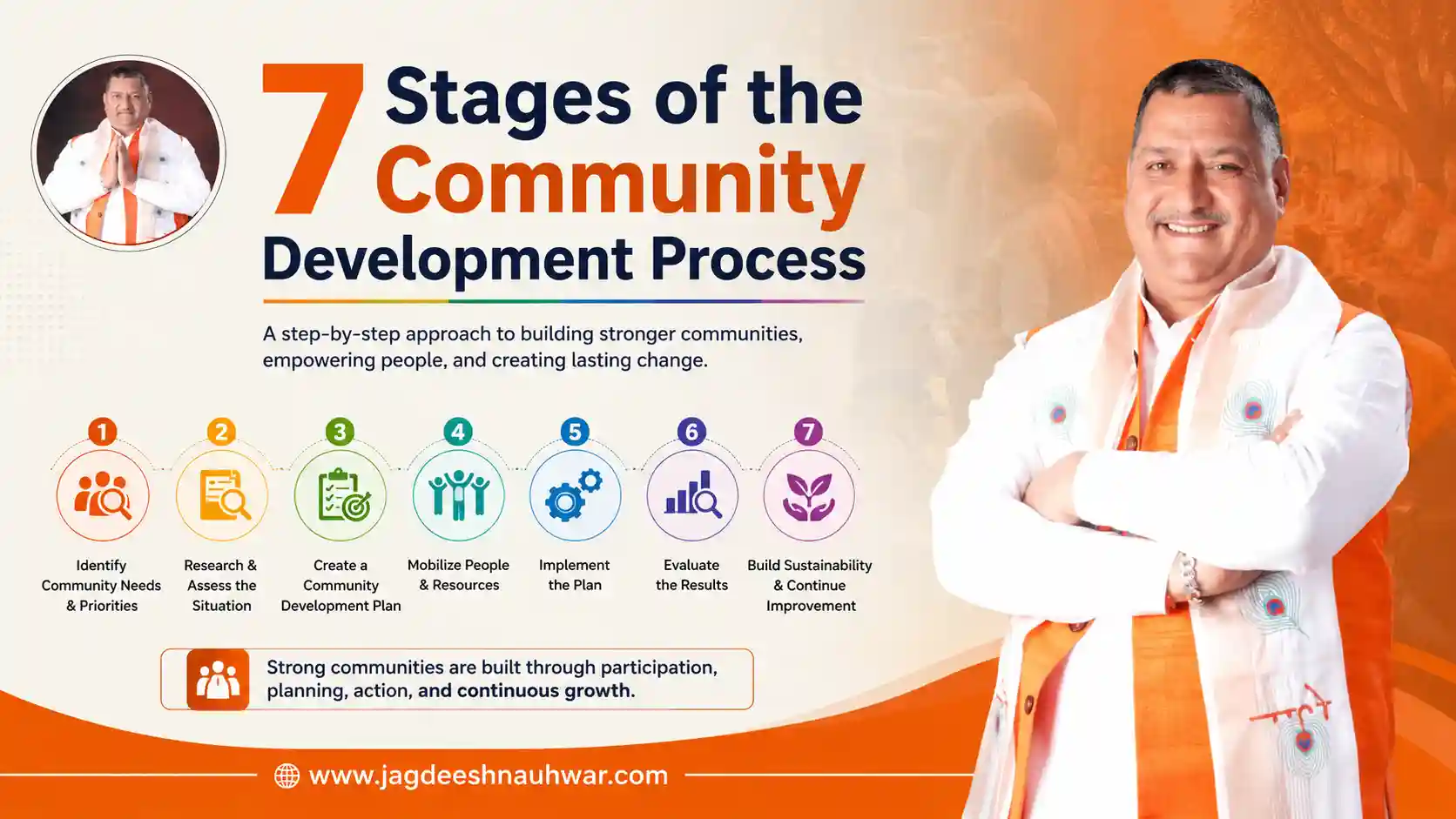
What are the 7 Stages of the Community Development Process?
Quick Answer:
The 7 stages of the community development process are 1) identifying community needs, 2) research and assessment, 3) planning, 4) community mobilization, 5) implementation, 6) evaluation, and 7) sustainability and continued improvement. These stages provide a practical framework for helping communities identify shared problems, organize resources, take action, measure results, and maintain positive change.
Community development is not a one-time activity. It is a participatory process in which residents, community organizations, social workers, leaders, government bodies, and other stakeholders work together to improve local conditions. Different organizations may describe the stages differently, and real community projects often move back and forth between stages rather than following a perfectly straight line.
Key Takeaways
The 7 stages can be remembered simply as:
- Identify – Understand community needs.
- Assess – Research the situation and available resources.
- Plan – Set priorities, objectives, and actions.
- Mobilize – Bring people, partners, and resources together.
- Implement – Put the plan into practice.
- Evaluate – Measure results and learn from experience.
- Sustain – Maintain progress and continue improving.
What Are the 7 Stages of the Community Development Process?
1. Identify Community Needs and Priorities
The first stage is understanding what the community actually needs.
Instead of assuming what people want, community development begins by listening to residents and identifying shared concerns. These may include:
- Education and skill development
- Employment opportunities
- Healthcare access
- Roads and infrastructure
- Clean water and sanitation
- Youth development
- Women's empowerment
- Environmental concerns
- Social welfare
Community meetings, surveys, interviews, focus groups, and discussions can help identify the most important issues.
The goal: Clearly define the problem before trying to solve it.
2. Research and Assess the Situation
Once a concern has been identified, the next step is to understand it properly.
This involves collecting relevant information about the community, examining existing resources, identifying gaps, and understanding the causes of the problem. Community members should be part of this process because local experience can reveal issues that statistics alone may not show.
A good assessment answers questions such as:
- What is causing the problem?
- Who is affected?
- What resources already exist?
- What organizations can help?
- What barriers could prevent progress?
The goal: Make decisions based on evidence, local knowledge, and real community conditions.
3. Create a Community Development Plan
After understanding the situation, the community can develop a practical plan.
The plan should establish clear priorities, objectives, responsibilities, resources, and timelines. It should also identify how progress will be measured.
For example, if a community identifies youth unemployment as a priority, the plan might include career guidance, vocational training, partnerships with local businesses, and employment-focused workshops.
The goal: Turn community concerns into realistic and measurable objectives.
4. Mobilize People and Resources
A strong plan needs people and resources to become reality.
Community mobilization brings residents, volunteers, local organizations, social workers, government agencies, educational institutions, businesses, and other stakeholders together.
This stage may involve:
- Recruiting volunteers
- Building partnerships
- Forming community groups
- Developing local leadership
- Securing funding or materials
- Assigning responsibilities
This is where community participation becomes especially important. People are more likely to support a project when they have a meaningful role in creating and delivering it.
The goal: Build collective ownership and the capacity to take action.
5. Implement the Plan
Implementation is the stage where ideas become action.
The community begins carrying out the activities agreed upon during planning. Depending on the project, this could mean organizing educational programs, improving local facilities, conducting awareness campaigns, supporting vulnerable families, developing employment initiatives, or advocating for better public services.
Successful implementation requires coordination and flexibility. Unexpected challenges may arise, so the original plan may need to be adjusted.
The goal: Deliver practical activities that address the identified community need.
6. Evaluate the Results
After implementation, the community needs to determine whether the project actually made a difference.
Evaluation involves comparing results with the original objectives. Feedback from residents and stakeholders is also important because numbers alone may not capture the full impact of a community initiative.
Useful questions include:
- What changed?
- Were the objectives achieved?
- Who benefited?
- What worked well?
- What problems occurred?
- What should be improved?
Evaluation is not about finding fault. It is about learning and making future community initiatives more effective.
The goal: Measure impact, learn from experience, and improve future action.
7. Build Sustainability and Continue Improvement
The final stage focuses on making positive results last.
A successful community project should not disappear as soon as the initial funding, campaign, or leadership effort ends. Sustainability may involve training local people, developing long-term partnerships, securing continuing resources, creating local organizations, or integrating successful programs into existing community systems.
Community development is also cyclical. After evaluating one initiative, new needs may emerge, requiring the community to return to assessment and planning.
The goal: Protect progress, strengthen local capacity, and encourage continuous development.
Why Are These 7 Stages Important?
The 7 stages of the community development process provide structure without removing community participation. They help ensure that projects are based on real needs rather than assumptions.
A well-managed process can:
- Encourage people to participate in local decisions
- Build stronger community relationships
- Make better use of available resources
- Improve accountability
- Develop local leadership
- Create measurable outcomes
- Support long-term community improvement
The process also recognizes that community development is about empowerment, not simply delivering services. Effective development gives people opportunities to participate in identifying problems, making decisions, taking action, and maintaining results.
What Role Does a Social Worker Play in Community Development?
Social workers can contribute at several stages of community development. They may help communities understand their needs, connect residents with services, encourage participation, build partnerships, support vulnerable groups, and evaluate programs.
A Jagdeesh Nauhwar Social Worker approach to community-focused work can be understood through the broader principle of listening to people, encouraging participation, and supporting practical solutions to local challenges. The important point is that sustainable community development works best when local people have a meaningful voice in the process.
How Is Community Development Connected to Social Development?
Community development and social development are closely connected, but they are not exactly the same.
Community development often focuses on collective action within a particular community, while social development has a broader focus on improving people's well-being, opportunities, equality, participation, and quality of life.
For a broader explanation of this connection, readers can explore “What Is Social Development and Why Is It Important?” as a related topic.
Is the Community Development Process Always Linear?
No. The seven stages are best viewed as a flexible framework rather than seven rigid steps.
A community may discover new information during implementation, for example, and return to the planning stage. Evaluation may reveal another urgent need, leading to a new assessment. Some models also use different names or combine certain stages. Research on community development emphasizes that there is no single universal set of instructions and that flexibility is important.
